Ordination Programme for India
An opportunity for the people of India to train in the Buddha's way
An opportunity to train
This programme opens the way for men of India to train themselves as the Buddha taught, and to practise the Dhamma correctly, under guidance.
Participants ordain as novices at Sarnath, where the Buddha first taught. Training is held at the Chinese Temple, Sarnath, and the novice ordination takes place at the Dhamek Stupa.
They keep the precepts, practise the Dhamma, and learn a Buddhist way of daily life that they can carry home to their families.
Training is led by a Thai monk of 24 rains — ordained for 24 years.
You can take part for a few days, or you can stay and train for years.
There is no charge to take part in the programme — short-term or long-term.
Two ways to take part
Come for a few days, or come to stay.
A few days in robes
Join one of the six intakes on its fixed dates. Arrive about three days before the ordination and keep the eight precepts while you prepare.
If you cannot come that early, you may arrive the day before the ordination.
You ordain as a novice and spend three full days in robes, learning the precepts and how to meditate. You return to lay life on the morning of the fourth day.
Apply — short-termFive years to become a teacher
You should come from the very start of the programme, with Intake 1 (arrival Thursday 11 February 2027).
You stay on as a novice at Sarnath and learn Thai until November. In November a committee assesses each novice. Those found suitable receive full ordination in Thailand in December 2027, then study and train there in virtue and meditation for five full calendar years. For those not selected, the committee decides whether they stay on at the Chinese Temple or return to lay life. More about the long-term path
Apply — long-termWho can apply
- Male by birth
- Aged 20 or over
- For the long-term path: aged no more than 40
- For the long-term path: registered as a Buddhist in India
- For the long-term path: able to eat whatever food is offered, including meat — monks in Thailand eat what lay people offer
- No chronic illness and no serious infectious disease
- Able to communicate in English
- Able to follow the rules and regulations of the programme
Applying from outside India? See the International Ordination Programme.
2027 schedule
Six intakes, all at Sarnath, India — training at the Chinese Temple, ordination at the Dhamek Stupa. Short-term participants join one intake; long-term participants should arrive with Intake 1 and stay on.
| Intake | Dates | Novice ordination |
|---|---|---|
| Intake 1 | 11–19 Feb | Sun 14 Feb |
| Intake 2 | 11–18 Mar | Sun 14 Mar |
| Intake 3 | 12–19 Apr | Thu 15 Apr |
| Intake 4 | 12–19 May | Sat 15 May |
| Intake 5 | 21–28 Jun | Thu 24 Jun |
| Intake 6 | 11–19 Jul | Wed 14 Jul |
Intake 1 stays one day longer to take part in the opening of a Dhamma chanting ceremony at Sarnath on Thursday 18 February.
Intake 6 stays one day longer to take part in Āsāḷha Pūjā on Sunday 18 July, the day the Buddha gave his first teaching, here at Sarnath.
All dates are in 2027 and are provisional; they may be adjusted as the programme develops.
| Intake | Short-term | Long-term | Total |
|---|---|---|---|
| Loading… | |||
Updated live from the application form. Apply now
| Reference | First name | Intake | Path | Status |
|---|---|---|---|---|
| Loading… | ||||
Reference number and first name only. Applied = has a place, to be confirmed on WhatsApp about four weeks before the intake · Confirmed = place confirmed · Reserve = on the reserve list for that intake.
A handbook to take home
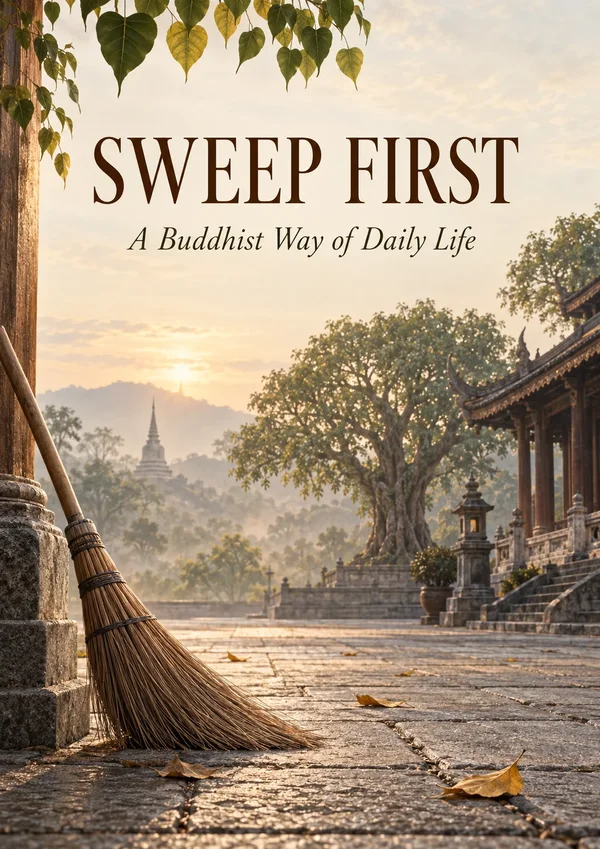
Sweep First
A Buddhist Way of Daily Life
Every participant receives this book, written for the programme in plain English.
A few days in robes is a short time. The book lets you keep learning on your own at home — what a Buddhist does each day, and why — and share it with your family.
The long-term path: teachers from India
For those who come to stay.
Long-term participants ordain at Sarnath, study and train in Thailand for five years, and then return to India to teach.
India is the birthplace of the Buddha's teaching and the most populous country in the world. Teaching the Dhamma there calls for many teachers. The long-term path sets out to raise those teachers from India itself, so that the work is carried by the people of the land.
The strength of the mother tongue
A monk who comes from abroad can teach in English, and reaches the people who speak it. A monk from India can teach in India's own languages — in the village, in the family, in the words people actually think in.
One Indian monk who understands the Buddha's teaching can carry it further and wider than any outsider could.
What such a monk needs is one thing: a sound knowledge of the Dhamma. The language, the culture and an understanding of the people he already has by birth.
Why Thailand
Thailand has a flourishing Buddhist tradition and a long-established system of monastic education. There a newly ordained monk learns both the Dhamma and Vinaya and the daily practice of monastic life as it is actually lived.
The years in Thailand are not study alone. Each monk also trains in virtue (sīla) and in meditation (samādhi), living under the guidance of his preceptor and teachers (nissaya) as the Vinaya asks of a new monk. The programme keeps each monk in Thailand for five full calendar years, from December 2027 to December 2032.
On his return, each monk has completed his training in full, with the knowledge to be a refuge for the people of India.
The path, step by step
| Stage | When | Where | What happens |
|---|---|---|---|
| 1 | From 11 February 2027 | Sarnath, India | Eight precepts at the Chinese Temple, then novice ordination (pabbajjā) at the Dhamek Stupa with Intake 1 |
| 2 | Until November 2027 | Sarnath, India | Learning Thai as a novice, and preparing for travel |
| 3 | November 2027 | Sarnath, India | Assessment by the committee: who continues to Thailand. For those not selected, the committee decides whether they stay on at the Chinese Temple or return to lay life |
| 4 | December 2027 | Thailand | Full ordination as a bhikkhu (upasampadā) |
| 5 | December 2027 – December 2032 | Thailand | Study of the Dhamma and Vinaya, with training in virtue and meditation, for five full calendar years |
The last intake is in July, so that everyone on the long-term path has time to learn Thai before travelling to Thailand in November.
Those who choose to stay on after their intake become mentors to the novices of the intakes that follow, so each intake can welcome more candidates than the one before.
Our aim for the first year is at least 30 novices ready to travel to Thailand for full ordination in December 2027.
Questions and answers
Answers from the Programme Director. Anything else — ask on WhatsApp, in any language.
Costs
Do I have to pay anything?
No. You pay nothing to take part in the programme. Anything outside the programme — for example your travel to Sarnath — is your own responsibility.
Long-term: who pays the flight to Thailand and the visa?
The programme pays your flight to Thailand and arranges your visa.
Long-term: what if I need to go home early?
An early or emergency trip home is at your own cost. At the normal end, after five years, the programme arranges your return to India.
Long-term: what about medical care in Thailand?
It is fully looked after. The temple has its own small hospital, and refers patients to other hospitals when needed.
Before you come
What should I bring?
The full list of what to bring will be announced in December 2026, after the team has visited the venue.
For now, please keep ready your national ID card (for example Aadhaar) — you will need it on arrival to show you are the person who registered — and, for the long-term path, your passport.
How do I get to the temple, and when should I arrive?
Travel to the Chinese Temple, Sarnath, by yourself, and arrive before 5 pm. After dark the gate is closed and it is hard to get in.
If your flight or train will make you late, tell us in advance. If you will arrive very late, stay in a hotel that night and come the next morning.
Should I shave my head before I come?
If you arrive at the start of the intake (about three days before the ordination), you may shave before coming, or not.
If you arrive only on the day before the ordination, you must arrive with your head and eyebrows already shaved — there will be no time, because the team is preparing the ceremony.
Registration
When will I know if I have a place?
Applying gives you a place in the queue for your intake. It is not yet a confirmed place.
The team checks every application against the conditions. About four weeks before your intake, our WhatsApp number +66 82 195 6535 sends you a message. Tap "Yes, I will come" and your place is confirmed. Please save this number in your phone so the message reaches you.
If you do not answer within 7 days, or your application does not meet the conditions, your place goes to the next person on the reserve list.
The list of participants is on this page (Table 3).
How does the reserve list work?
Once an intake is full, new applications go on the reserve list, in the order they arrive.
When a place opens — someone cannot come, does not answer in time, or does not meet the conditions — the next person on the list receives a WhatsApp message offering the place, and has 7 days to accept it.
The reserve list also lets the team prepare more space, equipment and training staff. If everything can be arranged, people on the reserve list may ordain in that intake too.
What if my plans change after I confirm?
Please tell us in the WhatsApp chat as soon as you can. Your place can then go to someone on the reserve list, and you are welcome to apply for a later intake.
What is checked when I arrive?
Bring your national ID card (for example Aadhaar). We check it against your application. If the details do not match, you cannot join the programme.
Long-term: is going to Thailand guaranteed?
No. Registering gives you a place at Sarnath. In November 2027 a committee assesses each long-term novice — conduct, keeping the precepts and the rules, living well with others, diligence in chanting and meditation, and progress in Thai.
Those found suitable go on to full ordination in Thailand in December. For those not selected, the committee decides whether they stay on at the Chinese Temple or return to lay life.
Daily life at the Chinese Temple
What is a day like?
- About 4:30 am — wake up
- 5:00 — chanting and meditation
- About 6:00 — duties, including cleaning the grounds
- About 6:30 or 7:00 — morning meal
- Late morning — Dhamma talk and meditation
- Afternoon — Dhamma talk and meditation
- Evening — chanting and meditation practice
- About 9:30 pm — lights out
Times may shift a little with the number of participants.
Where will I sleep?
In a shared dormitory — there are no separate rooms. If numbers overflow, tents with mosquito nets may be put up.
Can I use my phone?
Yes, during breaks. During talks, meditation and all activities, no phone use at all.
Is there a certificate for the short-term programme?
No. What you take home is the practice itself, and the handbook Sweep First to keep learning at home.
Can my family come?
Yes. Family may attend the ordination and take photographs, as long as they do not disturb the people conducting it, and they are welcome to help. They may visit during breaks.
Family may offer a meal to the novices — but only for all of them, never for one person — and must tell the team in advance, so that meals are not duplicated or wasted.
Short-term to long-term
Can I change from short-term to long-term?
Yes, if you meet the long-term conditions and bring a passport valid for at least six more years. If you are not sure yet, register short-term and bring your passport anyway.
Over 40, you cannot join the long-term path, but you may ask to stay on as a volunteer novice helping at the Chinese Temple. The committee decides.
Long-term conditions
I am married. Can I ordain?
Short-term: yes, no problem. Long-term: your wife must agree and be able to manage while you are away. Please also tell your parents that you are ordaining long-term.
I have debts, or a legal case. Can I ordain long-term?
Debts: you need your creditor's written, signed agreement to defer repayment — and only if the debt is small. With a large debt, do the short-term ordination first, and come for long-term once the debt is paid or nearly paid.
Legal cases: only once the case is fully closed. If it is still going on, please settle it first.
Why must long-term applicants be Buddhist?
Under the Vinaya, a person coming from another religion must first complete a four-month probation (parivāsa). To keep the path simple, the long-term programme takes registered Buddhists only. People of any religion are welcome on the short-term programme.
Is there a minimum education level?
No. You only need to be able to communicate in English.
The years in Thailand
What will I study in Thailand?
Nak Tham (the Thai Dhamma examinations) and Pali are available for those who enrol, along with training in the Dhamma and Vinaya, meditation, and virtue. All of it is taught in Thai — which is why you learn Thai before you go.
Can I visit home during the five years?
Yes, at your own cost, with the permission of the mentor monk who looks after you in Thailand. Whether the programme can fund a visit depends on donations at the time.
Where will I go after the five years?
The team expects to have a vihara in India ready within the five years, before you return, and returning monks will live there.
If it is not ready yet, that is no problem: you can stay at our branch temple in Nagpur, or you may be able to get a visa to go back and live in Thailand again. This will depend on the situation at that time.
You will not be left without a place to live.
What if I want to stop?
You can stop at any time — either move to another temple, or disrobe and return to lay life. Either way, the journey home is at your own cost.
Meditation and more
What kind of meditation is taught?
A middle way. Techniques are not fixed to one method — the Buddhist tradition has many, ancient and modern — so that each person can get past the obstacles in his own practice.
Can women join?
Not at present. This is an ordination programme for monks, and during the ordinations there is no space to host women keeping the eight precepts overnight. If you can offer a venue free of charge for an eight-precept programme for women, please tell the team.
Support the programme
Bank transfer
- Account name
- DHAMMACAKKA FOUNDATION TRUST
- Bank
- State Bank of India, ADB Sarnath
- Account no.
- 44478461369
- IFSC
- SBIN0004560
After transferring, please upload your payment slip on the donation page so that we can record your gift and send your receipt.
Questions? Ask on WhatsApp
All details of the programme are answered on our WhatsApp line.
- Who can ordain, and help with the application form
- Which intake to join
- Life as a novice and study in Thailand
- Supporting the programme
Programme Director
Ven. Anusorn Saraṇaṅkaro
Dhammacakka Foundation Trust, Sarnath